
Aristarchus
An ancient Greek "conspiracy theorist" battles rejection, ostracization during his relentless illumination of the truth

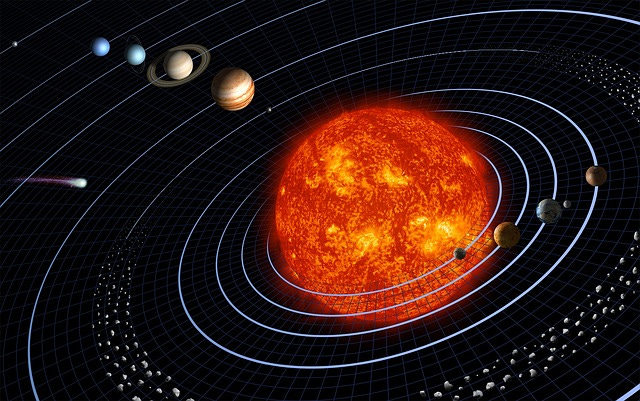
If you’re like me, while you were in school you learned that the great Renaissance mathematician and astronomer Copernicus discovered our planetary system is heliocentric in nature. But long before Copernicus was even born, a little-known, inquisitive Greek astronomer and mathematician who dared to dissent from his fellow scholars was actually the first to posit that we revolve around the sun. Almost 1,800 years before Copernicus, there was Aristarchus.
Aristarchus lived between 310 BC and 230 BC, and studied at philosopher Aristotle’s lyceum under Strato of Lampsacus who was in charge of Aristotle's school. During this time, the “settled science” of the day was that our universe was geocentric, meaning that scholars believed the sun revolved around us. Aristotle, Plato, and many others accepted this because they believed Earth had to be a fixed body, otherwise you could detect motion of the heavens here on earth. And to the naked eye the heavens look still.
Cue Aristarchus. I mentioned above he was the first to suggest our planetary system is heliocentric. How did he figure this out? Along with his groundbreaking discovery about the sun, he figured out why objects appear to be still when you’re moving while others don’t. Now known as the scientific principle of Parallax, he figured out a way to tell if you are moving by “tracking” an object and then using instruments to calculate how fast you are going and the distance you are from the object.
For instance, when you are driving on a highway trees closest to you seem to fly by while trees that are much further away seem to stay with you as you move. This example of parallax is compounded when you take into account the sun, or the moon, and the vast amount of distance between those two bodies and the earth. The long distances between the earth, moon, and the sun make motion appear stationary to the naked eye. However, with his instruments, observations, and calculations Aristarchus was able to prove we are the ones moving, not the sun.
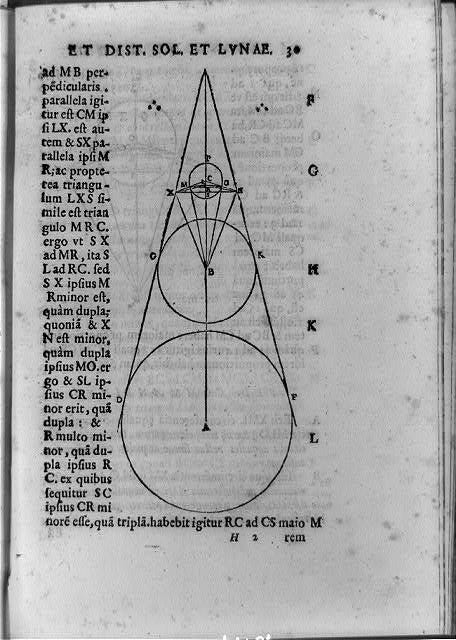
These are revolutionary discoveries that would have propelled civilization forward lightyears ahead of Aristarchus’ time. The only problem? No one believed him.
Instead of taking his discoveries and theories and testing them out to see if they had merit, scholars of all kinds made fun of him, shunned him, and paid no mind to his work- all in the name of a geocentric theory that was grounded in “sound science.” Even worse, they discredited his work because he was more well-known as an astronomer, not a mathematician. Ancient Greeks often turned up their noses to this particular scientific branch still in many ways rooted in infancy.
Did Aristarchus back down? Did he cower in a corner and abandon his work because of social ostracization? No. Instead, he bravely remained committed to his work, publishing books pertaining to specific calculations regarding the distance and size of the moon in relation to Earth. He continued to posit his heliocentric theory was correct. He never stopped discovering, learning, and thinking.
Like many ancient Greek texts, most of Aristarchus’ work was lost. His work On The Sizes and Distances of the Sun and Moon was preserved, and he is mentioned in letters written by other mathematicians such as Archimedes. Though he was critical of Aristarchus, he at least gave credit where credit was due in regards to his theories about the sun.
When you read Aristarchus’ story, you feel like you could be reading a story out of today’s scientific community. If a thinker as brilliant as Aristotle, the father of Reason, can be duped into adopting a mystic-like faith when it comes to certain theories of science, think of how much easier it is for far less brilliant minds today to accept blind truths instead of tirelessly searching for objective truth.
In today’s increasingly bureaucratic scientific communities, we see professionals on all levels chasing money, power, and governmental security. Making profits is a good thing, but how one makes a profit is everything.
Scientists chase money, power, and security at the expense of reality, of truth, of what is.
As a result, sectors that should make the principle of objectivity their guiding compass are twisting statistics, the scientific method, and results to fit into whatever truth they need to stay in the good graces of government officials across the globe.
Following Aristarchus’ pioneering work, much of Europe ultimately disintegrated into a cult of mysticism during the 1,000-year span known as The Middle Ages (or more appropriately, The Dark Ages). When Copernicus finally came along in 1473, this period of violence, dogma, and suffering had come to an end. His heliocentric findings were more readily accepted, thus advancing civilization into a wave of mathematical, scientific, and astronomical discovery.
What if Copernicus’ discoveries were tossed aside like Aristarchus’? Generations before us would be resting on a host of theories and accepted truths about the universe that would be utterly false. Who knows how far behind we would be with scientific advancement in present day civilization if dismissing new scientific theories because the “science is already settled” was the norm instead of the exception.
Today’s scientific communities operate more and more based on political dogma instead of sound reason. Perhaps now more than ever we need brave thinkers like Aristarchus. We need dissenters who dare to question authority. We need scholars in love with digging passionately for truth instead of ideological power.
Can you imagine if society as we know it today was built on the “settled science” of past generations? Eugenics would still be in vogue. Forced sterilizations would still be happening across America. We would have never made it to the moon, launched satellites, or discovered how to fly. Doctors would still be giving lobotomies in their offices.
Where would we be if no one listened to Einstein’s mind-bending work on the Theory of Relativity?
Civilization improves based on those who dare to question and say “no,” not those who blindly follow and are quick to say “yes.”
The much-needed scientific tradition of questioning accepted narratives can be found in Joanna Moncrieff’s recently published work debunking serotonin’s role with depression, which up until now was at the heart of doctors’ approach to treating patients suffering from the disorder. With two decades of passionate, relentless research under her belt, Dr. Joanna Moncrieff turned an accepted scientific universal truth since 1965 into a myth.
I think Aristarchus would be proud.
Thank you for reading! Freedom Journal runs on voluntary donations, and if you’d like to contribute to help me continue creating liberty-minded content, I’ve listed a few ways below. Thank you in advance!
Seeing this pattern prove true in so many places today - thank you for a historical example to show that it's far from being a new pattern, and that the reactions to those who are ahead of the curve seem never to change. Great piece!